

Editor’s Note
Prof. Madhumita Bhattacharya, teaches Business Communications at Globsyn Business School – which has always been considered to be one of the best b schools in Kolkata. Prof. Bhattacharya has more than 20 years of experience across various premiere academic institutions of Eastern India, where she has held leadership positions. She has demonstrated ability in teaching as well as relevant academic administration. Her core areas of expertise include Business Communication, Interpersonal Skills, Professional Etiquette, Interview Skills, and Networking Strategies. She has been part of several industry-academia training programs, and has conducted workshops. Her teaching is marked by a blend of business acumen and psychological insights, which she leverages to enhance students’ understanding of effective communication in professional settings. Prof. Bhattacharya has proven expertise in Curriculum Design, Performance Evaluation & Mapping, and Training Needs Analysis (TNA). She has been part of various MDPs and FDPs, and is a joint recipient of the Education Excellence Award by Times of India.
In a world defined by volatility, uncertainty, complexity, and ambiguity (VUCA), organizations are increasingly recognizing the value of maintaining multiple viable pathways while navigating change. Rather than committing prematurely to a single course, such flexibility enables firms to experiment, adapt, and pivot with minimal sunk costs. Strategy research on real options, dynamic capabilities, and exploratory learning similarly argues that organizations benefit from generating and preserving alternative courses of action until environmental signals clarify. Within this scholarly stream, the GARC model—Generate, Assess, Retain, Convert, can be understood as an integrative process framework that translates these theoretical insights into managerial practice. Firms first create diverse strategic possibilities, then evaluate them under evolving conditions, maintain promising ones at low commitment, and finally scale those aligned with emerging opportunities.
The development of Strategic Options should be an ongoing priority for any business that hopes to persist for years to come. Importantly, they can help organizations manage risk by diversifying a broad portfolio of initiatives. Organizations can reduce their exposure to risks associated with a single course of action. Additionally, since Strategic Options are developed in advance of an actual emergency or critical situation, you can take time and involve key stakeholders in the development. Bad decisions are made during a panic; planning avoids that risk.
Strategic optionality rests on the principle that long-term competitiveness depends less on predicting the future and more on being prepared for multiple plausible futures. The GARC model operationalizes this idea:
- Generate: Create diverse strategic options through innovation, partnerships, capability building, or market exploration.
- Assess: Evaluate options against evolving environments—technological, regulatory, and competitive.
- Retain: Preserve promising options at low cost (e.g., pilot projects, minority investments, skill pipelines).
- Convert: Scale selected options into full strategies when conditions align.
This cycle mirrors agile learning loops: exploration precedes commitment, and evidence guides investment.
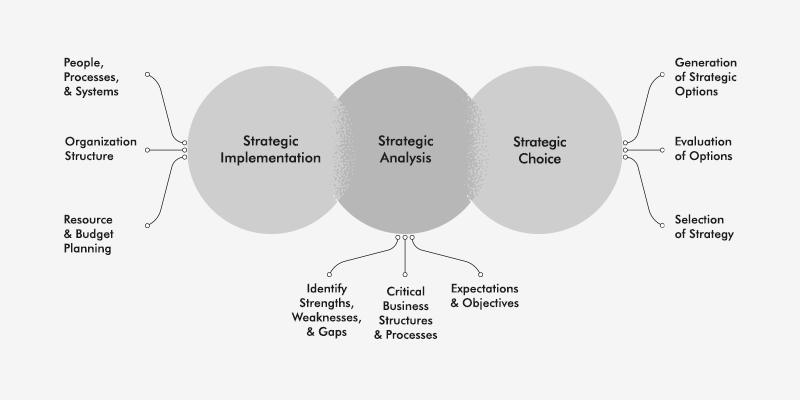
Consider firms in renewable energy, digital finance, or AI-driven services. Leaders often launch small experiments – joint ventures, prototypes, or regional pilots – without immediate large-scale deployment. These initiatives represent retained options: they are not yet core strategies but can be rapidly converted if market signals strengthen. The GARC model clarifies this logic that organizations should not discard uncertain opportunities prematurely, nor overinvest before validation.
For managers, the challenge is balancing focus with flexibility. Too many options create diffusion; too few create rigidity. GARC emphasizes disciplined optionality: structured generation, continuous assessment, selective retention, and timely conversion
When viewed through the educational philosophy of Globsyn Business School, GARC also reflects how institutions can cultivate future managers capable of structured adaptability in uncertain environments.
Teaching strategic optionality shifts managerial thinking from deterministic planning to adaptive strategy. Students trained in the GARC mindset learn to:
- Design portfolios of strategic bets rather than single plans.
- Use data and feedback loops for option assessment.
- Maintain “real options” through partnerships and skill development.
- Recognize inflection points for conversion and scaling.
In careers marked by technological disruption and shifting business models, such capability becomes a durable advantage.
Strategic optionality is no longer a luxury, it is a survival skill. It provides a structured pathway to cultivate and manage options amid uncertainty. When integrated with Globsyn’s philosophy of globally aware, ethical, sustainable, and industry-ready management education, it becomes more than a strategy tool – it becomes a mindset. Future leaders trained to generate, assess, retain, and convert options will not merely respond to change, they will shape it.

Prof. Madhumita Bhattacharya
Faculty – Business Communications
Globsyn Business School