

Editor’s Note
Prof. Madhumita Bhattacharya, teaches Business Communications at Globsyn Business School – which has always been considered to be one of the best b schools in Kolkata. Prof. Bhattacharya has more than 20 years of experience across various premiere academic institutions of Eastern India, where she has held leadership positions. She has demonstrated ability in teaching as well as relevant academic administration. Her core areas of expertise include Business Communication, Interpersonal Skills, Professional Etiquette, Interview Skills, and Networking Strategies. She has been part of several industry-academia training programs, and has conducted workshops. Her teaching is marked by a blend of business acumen and psychological insights, which she leverages to enhance students’ understanding of effective communication in professional settings. Prof. Bhattacharya has proven expertise in Curriculum Design, Performance Evaluation & Mapping, and Training Needs Analysis (TNA). She has been part of various MDPs and FDPs, and is a joint recipient of the Education Excellence Award by Times of India.
KEY TAKEAWAYS
- Diversity, Equity and Inclusion (DEI) are essential for building future-ready organizations and educational institutions.
- Diversity brings together people with different identities, experiences, backgrounds, and perspectives.
- Equity ensures fair access to opportunities, resources, support, and career growth based on individual needs.
- Inclusion creates environments where people feel respected, heard, valued, and empowered to participate.
- DEI priorities differ across countries and cultures, but the broader goal remains equal participation and opportunity.
- Inclusive workplaces can strengthen innovation, employee engagement, productivity, collaboration, and decision-making.
- At Globsyn Business School, diverse classrooms help students develop empathy, cultural awareness, confidence, critical thinking, and global leadership skills.
Two employees join the same organization on the same day. Both are equally qualified, equally ambitious, and equally capable. Yet, one feels heard in meetings, finds mentors easily, and grows confidently within the company. The other struggles to fit in, hesitates to speak up, and constantly feels the need to “adjust” to the workplace culture.
The difference is not talent. Often, the difference lies in whether the organization truly practices Diversity, Equity, and Inclusion (DEI). It focuses on creating environments where individuals from different backgrounds feel respected, valued, and empowered to contribute meaningfully.
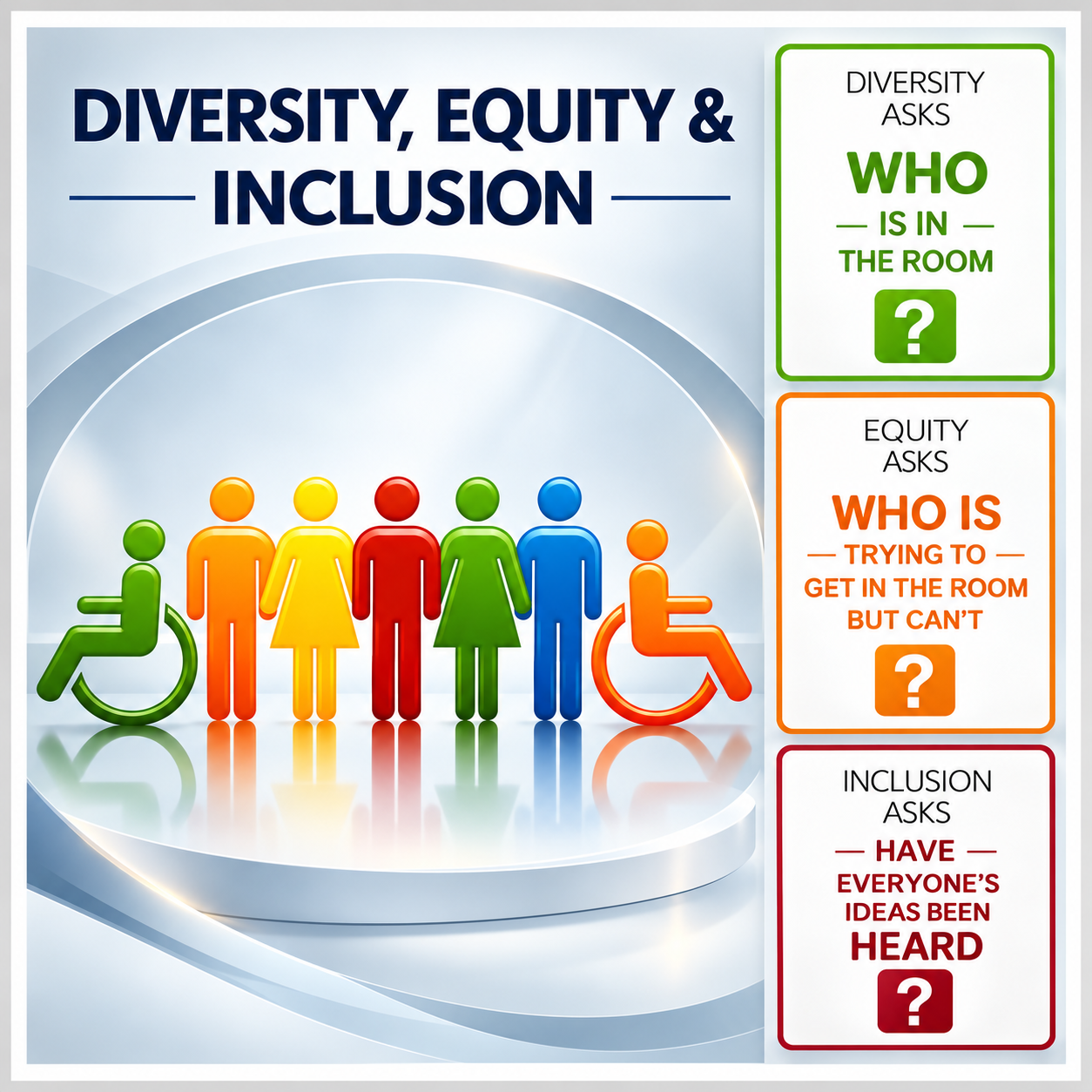
Diversity refers to the presence of differences among people, including gender, age, ethnicity, religion, disability, socio-economic background, and sexual orientation. Equity emphasizes fairness by ensuring that opportunities and resources are distributed according to individual needs and circumstances. Inclusion ensures that every individual feels welcomed, heard, and included in decision-making and participation. An extended version of the framework, known as DEIA, additionally highlights accessibility for persons with disabilities.
Although the term DEI has gained popularity recently, the concepts behind it have existed for decades. Different countries approach DEI differently depending on their social realities. In India, DEI discussions often focus on workplace inequalities related to gender, caste, religion, and patriarchal social structures. In countries like Japan and Iceland, the focus is more on gender and age equality, while Australia emphasizes Indigenous inclusion and gender diversity. These differences indicate that DEI is not a universal template but a framework shaped by cultural and societal contexts.
Organizations increasingly recognize that diverse and inclusive workplaces contribute to innovation, creativity, and better decision-making. Employees from varied backgrounds bring different perspectives, helping companies understand broader customer needs and solve problems more effectively. Studies have repeatedly shown that inclusive organizations often experience stronger employee engagement, improved productivity, and better financial performance.
Several multinational corporations have actively incorporated DEI into their organizational strategies. Microsoft has invested heavily in accessibility-focused technologies and inclusive workplace policies. Accenture has introduced initiatives promoting gender-balanced leadership and LGBTQ+ inclusion, while Unilever has worked toward reducing recruitment bias and improving representation across its workforce. Indian companies such as Infosys and Tata Consultancy Services have also strengthened diversity hiring and accessibility initiatives, demonstrating that DEI is becoming increasingly relevant in Indian corporate culture.
The relevance of DEI extends beyond corporations and is equally important in educational institutions like Globsyn Business School (GBS). As a business school preparing students for global corporate environments, GBS plays a significant role in shaping socially responsible and culturally aware future leaders. A diverse classroom environment allows students to interact with peers from different backgrounds, encouraging broader perspectives, collaboration, and critical thinking. Inclusive academic spaces also help students feel confident in expressing ideas regardless of their language, culture, or socio-economic background.
However, DEI is not without criticism or limitations. One common concern is that some organizations adopt DEI merely as a branding or compliance exercise rather than implementing meaningful structural changes. Diversity initiatives may become symbolic if underrepresented individuals are included only for appearances without being given genuine opportunities or influence. Critics also argue that excessive emphasis on identity categories may sometimes create perceptions of division or preferential treatment.
Additionally, implementing DEI effectively requires continuous commitment, cultural sensitivity, and organizational accountability. Challenges such as unconscious bias, unequal representation, stereotypes, and lack of accessibility still persist across institutions and workplaces. Therefore, DEI should not be treated as a short-term trend but as a continuous process of learning, adaptation, and institutional change.
As workplaces and educational institutions become increasingly diverse, the real challenge lies not merely in representation but in creating environments where differences are respected and valued equally. In this context, Mahatma Gandhi’s words remain deeply relevant:
“Our ability to reach unity in diversity will be the beauty and the test of our civilization.”

Prof. Madhumita Bhattacharya
Faculty – Business Communications
Globsyn Business School