

Editor’s Note
Dr. Tanusree Chakraborty teaches Economics and Statistics at Globsyn Business School – top B Schools in India. Dr. Chakraborty has completed her Masters and Ph.D. in Economics from the esteemed Calcutta University. With over 15 years of experience in teaching and research, she has led several learning sessions for aspirants, in the field of Economics, Operations Research, Research Methodology, Statistics and Gender & Development. Dr. Chakraborty’s repertoire of work includes a number of published books and journals, wherein she has extensively contributed her knowledge about women’s economic empowerment in the present day. She has also been actively involved in events, seminars and conference proceedings of international repute.
KEY TAKEAWAYS
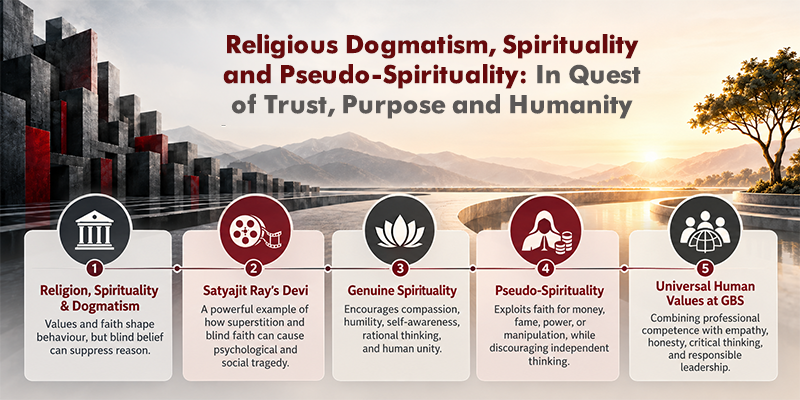
- Religion, spirituality, and dogmatism shape values, behaviour, and attitudes toward life.
- Religious dogmatism promotes blind belief, intolerance, conflict, and loss of independent thinking.
- Satyajit Ray’s Devi illustrates the psychological and social consequences of blind faith and superstition.
- Genuine spirituality encourages compassion, humility, self-awareness, critical thinking, and human unity.
- Pseudo-spirituality exploits faith for money, fame, power, or manipulation.
- True spirituality supports rational thought, responsibility, and ethical living.
- Universal Human Values help students combine professional competence with empathy, honesty, critical thinking, and responsible leadership.
- Globsyn Business School integrates UHV to develop conscious, ethical, and industry-ready professionals.
In human reasoning, religion and spirituality have historically been important factors that help shape values, social behavior, and the attitudes of the individual towards life’s ultimate questions. In any civilization, religion and spirituality can hardly be studied separately due to their interdependence. Though, when religious faith loses its balance and takes the shape of a fundamentalist belief system, conflicts may occur. Hence, understanding the differences between religion, spirituality, and dogmatism is crucial for modern life. The term dogmatism signifies the belief in one’s religion without any rational justification of faith. A dogmatic person believes that their own religion or ideology is the only correct one and all other systems of belief are false. Religious dogmatism has caused wars, persecutions, social discrimination, and conflicts throughout the history of humanity. People have suffered when religious groups or institutions did not accept their contrasting beliefs. When religion is too rigid, it ceases to fulfill its main goal of helping people in their spiritual and moral development. Instead of helping humanity, it starts to oppress and control people using fear and blind obedience. Dogmatism influences personal growth as well. A person restricted by rigid beliefs stops looking for truth on his own. The rituals and customs of religion become more important than kindness, honesty, and compassion.
In the movie “Devi,” directed by Satyajit Ray, we find a powerful artistic portrayal of religious dogmatism. The film depicts how blind belief in religions can lead to psychological and social wreckage of human life. The story is set in the nineteenth century in Bengal, and follows the story of a woman named Doyamoyee. Her father-in-law, Kalikinkar Roy, is so caught up in his devotion to religion that he begins to worship her as a living goddess after he dreams of Doyamoyee as the reincarnation of Goddess Kali. The idea is accepted without questioning by the family and the village. The story here is a tragic one, and Ray does not question the validity of religion; instead, he highlights the negative effects of blind faith and superstition. Doyamoyee loses her identity as an ordinary human being, and the role given to her by male authority becomes her only identity. Her suffering is a reflection of the destructive nature of dogmatism. Ray depicts how collective faith and emotional fascination triumph over reason and humanity
Additionally, the film illustrates how blind faith and rationality could be opposite ideologies through the character of Umaprasad, who happens to be Doyamoyee’s educated husband. He symbolizes all those virtues which belong to a modern educational facility, humanism, and reason. However, he fails to oppose numerously considered deeply embedded beliefs of his family as well as society. The final scenario of the story serves as a vivid illustration of the situation where irrational belief gives rise to a tragedy and emotional defeat. Unlike dogmatism, spirituality is an individual and inner journey where seekers search for truth, peace, self-awareness, and connection with the superior being. It cannot be confined to institutionalized religion.
Genuine spirituality inspires compassion, humility, empathy, and self-control. It teaches people how to rise above negative feelings such as greed, anger, violence, and egoism. Meditation, praying, contemplating, and helping people are often considered ways to achieve spiritual growth because all these activities lead to a person’s inner development. Spirituality is aimed at creating peace instead of conflict. It calls for human beings’ respect for each other regardless of their faith, position in society, nationality, and other aspects of their lives. Unlike dogmatism, spirituality promotes asking questions and finding answers for oneself. A spiritual being knows that the truth cannot be delivered in a forceful or frightening form. It is only possible to get to know the truth through love, knowledge, and awareness.
Numerous important thinkers gave importance to spirituality over dogmatic ritualism. Swami Vivekananda taught that serving humanity is the greatest worship. Rabindranath Tagore followed the path of universal humanism and believed in human unity. Mahatma Gandhi built his philosophy on spiritual principles of truth, simplicity, and non-violence. All of them showed that true spirituality is not based on rituals but on good morals and humane values. Unfortunately, today, together with real spirituality, pseudo-spirituality has emerged. Pseudo-spirituality is the fake or shallow spirituality that uses spiritual ideas for the sake of self-benefit in terms of money, fame, or power. Pseudo-spirituality includes spiritual vocabulary and symbols but does not possess sincerity, ethics, or depth.
The term false spirituality can seem appealing because it promises fast fulfillment, instant enlightenment, miraculous cures, and absolute success. Hence, many impostors in the field of spirituality take advantage of the individuals who are open to being manipulated. Pseudo-spiritual teachers prevent their followers from thinking independently and developing as persons. A key characteristic of false spirituality is that it draws attention to the visual image of the speaker. For example, there are people who express spirituality by wearing extravagant clothes, talking in a unique way, and using social networks. In contrast, the actions of these people can show that they are greedy, selfish, dishonest, and full of themselves.
An additional risk of pseudo-spirituality is the exploitation of spiritual ideas to escape reality. Certain individuals use spiritual expressions as a way of evading accountability, disregarding suffering, and denying the existence of actual social issues. Genuine spirituality involves coping with life rather than running away from it. A spiritually developed person understands that pain and hardship must be accepted in an attempt to achieve moral and emotional growth. The phenomenon of pseudo-spirituality may also promote superstitions and illogical reasoning. Blind faith in miracles, magical abilities, or self-styled saints impedes the development of scientific thought and critical thinking. Though spirituality and science can be friends, pseudo-spirituality tends to reject proof and rational thought.
In the modern society where social unrest and disinformation abound, it is necessary for people to recognize the difference between faith and fanaticism, spirituality and pretentiousness, and wisdom and deception. Religion should serve the purpose of promoting moral values and kindness to others instead of feeding hatred and intolerance. Spirituality should enhance self-knowledge and humanity instead of being associated with style or business. In the final run, the real aim of religion and spirituality is to elevate humanity. Moreover, a truly spiritual person is identified by his or her sincerity and goodwill rather than by any number of rituals or acts of worship.
Globsyn Business School’s application of Universal Human Values, which allows it to mold well-prepared specialists and competent professionals in fixing problems as the essence of their vocation by being a conscious individual. The teaching process on UHV is aimed at the harmonization of students in terms of being successful professionals and leading a fulfilling professional life. This course is comprehensive and goes beyond developing technical skills; it is focused on the improvement of critical thinking and strategic performance, but does not forget about the virtues of empathy and honesty.

Prof. Tanusree Chakraborty
Faculty – Economics
Globsyn Business School