

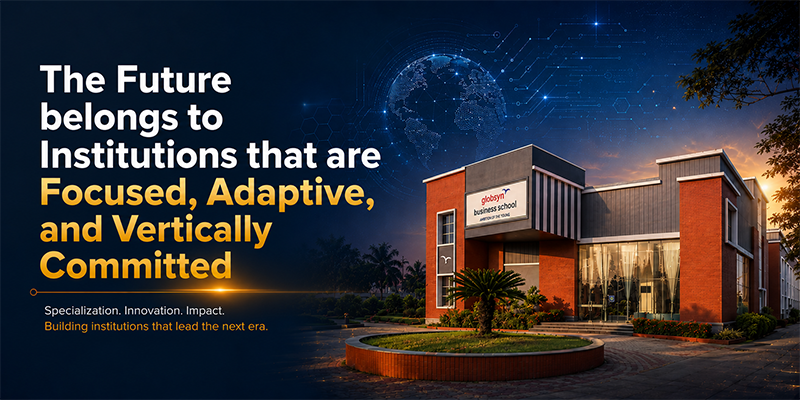
Gone are the days when generic academic institutions alone were enough. They may continue to exist, but their relevance may not. The AI revolution is fundamentally reshaping business, careers, decision-making, and even human relevance at a pace never witnessed before. Industries are evolving in real time, roles are being redefined every few months, and entire business models are being disrupted by technology, data, automation, behavioural intelligence, and human psychology.
In such a rapidly changing and time-sensitive world, specialized institutions become far more relevant than broad, generalized ecosystems. Just as a patient with a critical condition eventually seeks a specialist doctor rather than relying only on a general physician, students and industries today seek institutions that are deeply focused, continuously evolving, and vertically committed to a specific domain. That is the relevance of a modern business school.
A business school today is not merely teaching management; it is constantly reinterpreting management through the lens of AI, technology, analytics, sociology, communication, leadership, and industry transformation. The vision of NEP 2020 rightly recognizes this shift by enabling multidisciplinary learning within specialized institutions. The future will belong to institutions that can evolve rapidly, remain industry-aligned, and continuously refine expertise within their domain. That level of dynamism and depth is extremely difficult to achieve in broadly horizontal institutions managing multiple unrelated disciplines simultaneously. In many ways, the modern business school must function like a specialist doctor: focused, adaptive, research-driven, and deeply committed to solving the real challenges of the future economy.
This is precisely why specialized business schools are emerging as the preferred destinations for ambitious learners and forward-looking industries alike. They are agile enough to redesign curriculum at the speed of disruption, equipped to forge deep partnerships with corporates, and structured to nurture domain-specific intellectual capital. In an era where generic knowledge is freely available, what truly differentiates an institution is its ability to deliver depth, context, and applied expertise – turning learners into specialists ready to lead a future that the old educational model can no longer prepare them for.

Rahul Dasgupta
Director & Trustee
Globsyn Business School
Editor’s Note
Rahul Dasgupta, Director & Trustee of Globsyn Business School, is a prolific entrepreneur, investor, philanthropist, and corporate professional who leads the marketing and business functions for the Group’s forays in management education and technology training.
An alumnus of Durham Business School, UK, and a graduate of the accelerated development programs from Indian Institute of Management, Ahmedabad, India, and Wharton Business School, USA, Rahul has worked for Fortune 500 companies like Merrill Lynch & Co. Inc. and Deloitte & Touche and has had a successful industry stint prior to joining Globsyn.
A 2nd generation entrepreneur, Rahul has been instrumental in guiding and growing GBS as India’s only ‘Corporate B-School’, and is the chief architect behind the pedagogical change in the academic delivery system of GBS, which merges industry requirements with academic curriculum to build industry-relevant managers.Rahul also drives the ‘Beyond Education’ elements of GBS, which include care for society activities, live projects, entrepreneurship development and management conferences.
Rahul spearheads the technology training vertical of Globsyn, which has trained over 2,50,000 engineering students through the years in various emerging technology tracks like Artificial Intelligence, Machine Learning, Big Data, Blockchain among others.
Over the years, he has been honored with several accolades, which includes being recognized as an ‘Impactful Leader in Enhancing Excellence in Management Education in India’ at the ‘Exemplary Awards 2024 in Academia’, by Federation for World Academics (FWA).