

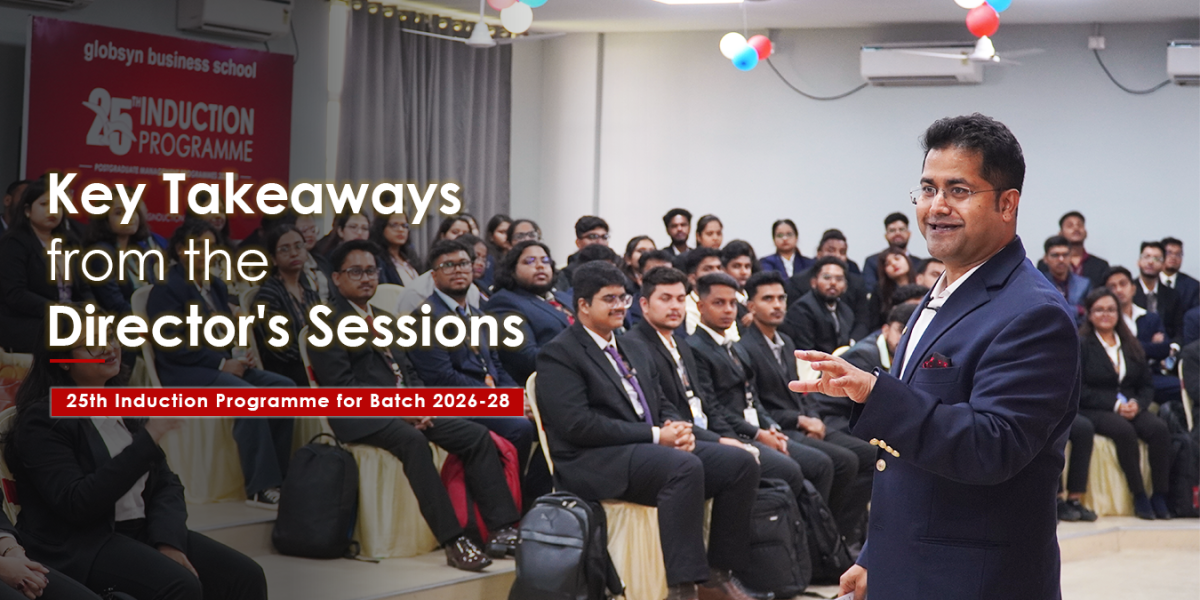
Every year, on induction day, I look out at a room full of new faces and I see the same three things: excitement, nervousness, and a very carefully hidden question – did I make the right decision? This year, at our 25th induction programme, welcoming the Batch of 2026-28, who also happens to be the 25th batch of the B-School, that question felt especially loud.
Twenty-five years is a long time to watch young people walk in through the same doors. I have seen thousands of them arrive, and I have seen many of them leave – some transformed, some merely certified. That difference is what I wanted to talk about. So I put my notes aside for a bit and spoke about the one thing nobody puts in a brochure.
Penned below are key takeaways from my session with the students of Batch 2026-28 pursuing PGDM, PGDM – Business Analytics, and MBA (Global) at this year’s induction programme.
1. Move from ROI to ROV – Return on Value
You have all done the maths. Fees, opportunity cost, expected salary, payback period. Every one of you has some version of that spreadsheet in your head, and some of you have parents who have it in an actual spreadsheet.
I am not going to tell you the maths is wrong. I am going to tell you it is incomplete.
Return on Investment gives you one number at the end of two years. Return on Value gives you everything else – the skills you pick up, the people you meet, the confidence you build, the things you learn about yourself that you did not know when you walked in. Ten years from now, when you look back at this campus, you will not remember your first CTC. You will remember who you became here. Measure that.
2. The journey matters as much as the outcome
There is a tendency to treat the MBA as a waiting room. Two years of queuing for placement season. Attend, submit, survive, get placed.
Please don’t do that. If you spend these two years waiting for the ending, you will get the ending and nothing else. The value is distributed across seven hundred-odd days – a case discussion that changes how you think, a club event you organised badly and learnt from, a conversation with a faculty member at 6 pm when everyone else has left. Those are not the build-up to the real thing. They are the real thing.
3. Growth happens where you are uncomfortable
I will make you a promise: something here will make you uncomfortable. A subject you do not understand. A professor who does not accept your first answer. A classmate who is sharper than you in exactly the area you thought was your strength.
Your instinct will be to move away from that. Drop the elective. Avoid the professor. Sit with people who make you feel competent.
Resist that instinct. Comfort is a lovely place, but nothing grows there. The subject you are worst at is usually the one with the most to teach you, and the person who intimidates you is usually the one you should be having coffee with.
4. Ask yourself: Am I choosing from fear, or from growth?
This is the single most useful question I know, and it costs nothing to ask.
Every time you make a choice here – a specialisation, a project, a team, a competition, whether to raise your hand – pause for five seconds and ask which one you are doing. Am I picking this because it will stretch me? Or because it protects me from the possibility of looking foolish?
Both answers are allowed. Sometimes fear is sensible. But you should at least know which one you are choosing, because over two years these small choices quietly add up into a person.
5. Understand how you learn
Somewhere along the way we were all told there is one correct way to study. Sit at a desk, read the chapter, make notes, revise.
For some of you that works beautifully. For many of you it never has, and you have spent years assuming the problem was you. It probably wasn’t. Some people learn by arguing. Some by teaching someone else. Some by building the thing and breaking it. Some need to hear it, some need to see it drawn on a board.
Find out which one you are, and then stop apologising for it. Nobody is coming to hand you a method. Your learning is your own responsibility now – that is genuinely the biggest shift from school and college to here.
6. Relationships are part of your education
I say this every year and I am not sure it is believed until much later: a very large share of what you take away from these two years will not come from a classroom at all. It will come from the people.
The batch you are sitting with today comes from different cities, different graduation streams, different families, different ideas of what success looks like. Your faculty have industry lives behind them. Our alumni are scattered across companies and countries and are, in my experience, remarkably willing to pick up the phone.
Use all of it. And please – build relationships outside your comfort group. The friend who is exactly like you teaches you very little.
7. Turn frustration into curiosity
Things will go wrong. You will lose a competition you should have won. A team will let you down, or you will let a team down. A grade will feel unfair. An interview will not convert.
In that moment, the natural response is frustration, and frustration is fine – feel it, briefly. Then change the question. Instead of why did this happen to me, ask why did this happen, and what is it showing me?
I can tell you from my own life that some of the most useful turns I have taken came directly out of things that felt, at the time, like setbacks. You rarely see it while it is happening. You see it later, looking back.
8. Listen, reflect, connect the dots
Attendance is the lowest form of participation. Being in the room is not the same as being in the session.
Listen properly. Take notes – actual notes, in your own words, not a photograph of a slide. Then do the part almost nobody does: go back and read them. Ask how the finance session connects to the strategy case, how the marketing lecture connects to that guest speaker from industry, how any of it connects to the way you handled last week’s group assignment.
Knowledge that sits in separate boxes is not much use. The value appears when the boxes start talking to each other, and only you can make that happen.
9. Be constructively selfish
I want to use a word we are usually taught to avoid. Be selfish about your own development.
These two years belong to you. Not to your parents, not to your peer group, not to the batch WhatsApp group’s idea of what you should be doing. So sit down honestly and work out where you are weak. Public speaking? Numbers? Writing? Working with people you disagree with? Then go and deliberately do something about it, even if nobody is grading you on it.
Nobody else is going to run your development plan. There is no such role.
10. Define your own ROV
Here is the one piece of homework I gave the batch, and I will repeat it here.
Before this week ends, write down at least three things you want to get out of your MBA that have nothing to do with placement. Be specific. Not “improve communication” – something you can actually see yourself doing. Put it somewhere you will find it again. Look at it at the end of every semester and ask yourself, honestly, whether you are any closer.
That list is your ROV. It is yours, it will not look like anybody else’s, and you are the only person who can audit it.
11. Master AI but never outsource your learning to it
I would be doing you a disservice if I did not talk about this.
Learn to use AI. Learn it properly, not casually. What a capable student can produce today with these tools was simply not possible a few years ago, and the gap between people who have genuinely mastered them and people who dabble is going to be enormous in your careers. That is a real advantage and I want you to have it.
But be very clear about the line. AI should make your thinking sharper, not optional. The moment you hand over the struggle – the reading, the reasoning, the messy first draft, the arriving at your own point of view – you have outsourced the very thing you came here to build. A polished answer you did not think through is worth nothing to you, whatever it looks like on the page.
The human must be in the lead, not merely in the loop. At GBS you will learn and practise our ethical AI framework, CARE for AI, alongside your faculty. Take it seriously. The people who will be trusted with real responsibility in the next decade are the ones who can use these tools with judgement, not the ones who can use them fastest.
None of what I said in my sessions was complicated. Most of it, honestly, is the kind of thing you only fully appreciate once the two years are behind you, which is precisely why I say it at the beginning, and why I will keep saying it at every induction.
Twenty-five batches have walked through Globsyn Business School. The ones who got the most out of it were not always the ones who arrived with the best scores. They were the ones who decided, fairly early on, that this was theirs to make something of.
Batch of 2026-28, welcome. The two years start now. Make them count.

Rahul Dasgupta
Director & Trustee
Globsyn Business School
Editor’s Note
Rahul Dasgupta, Director & Trustee of Globsyn Business School, is a prolific entrepreneur, investor, philanthropist, and corporate professional who leads the marketing and business functions for the Group’s forays in management education and technology training.
An alumnus of Durham Business School, UK, and a graduate of the accelerated development programs from Indian Institute of Management, Ahmedabad, India, and Wharton Business School, USA, Rahul has worked for Fortune 500 companies like Merrill Lynch & Co. Inc. and Deloitte & Touche and has had a successful industry stint prior to joining Globsyn.
A 2nd generation entrepreneur, Rahul has been instrumental in guiding and growing GBS as India’s only ‘Corporate B-School’, and is the chief architect behind the pedagogical change in the academic delivery system of GBS, which merges industry requirements with academic curriculum to build industry-relevant managers.Rahul also drives the ‘Beyond Education’ elements of GBS, which include care for society activities, live projects, entrepreneurship development and management conferences.
Rahul spearheads the technology training vertical of Globsyn, which has trained over 2,50,000 engineering students through the years in various emerging technology tracks like Artificial Intelligence, Machine Learning, Big Data, Blockchain among others.
Over the years, he has been honored with several accolades, which includes being recognized as an ‘Impactful Leader in Enhancing Excellence in Management Education in India’ at the ‘Exemplary Awards 2024 in Academia’, by Federation for World Academics (FWA).